
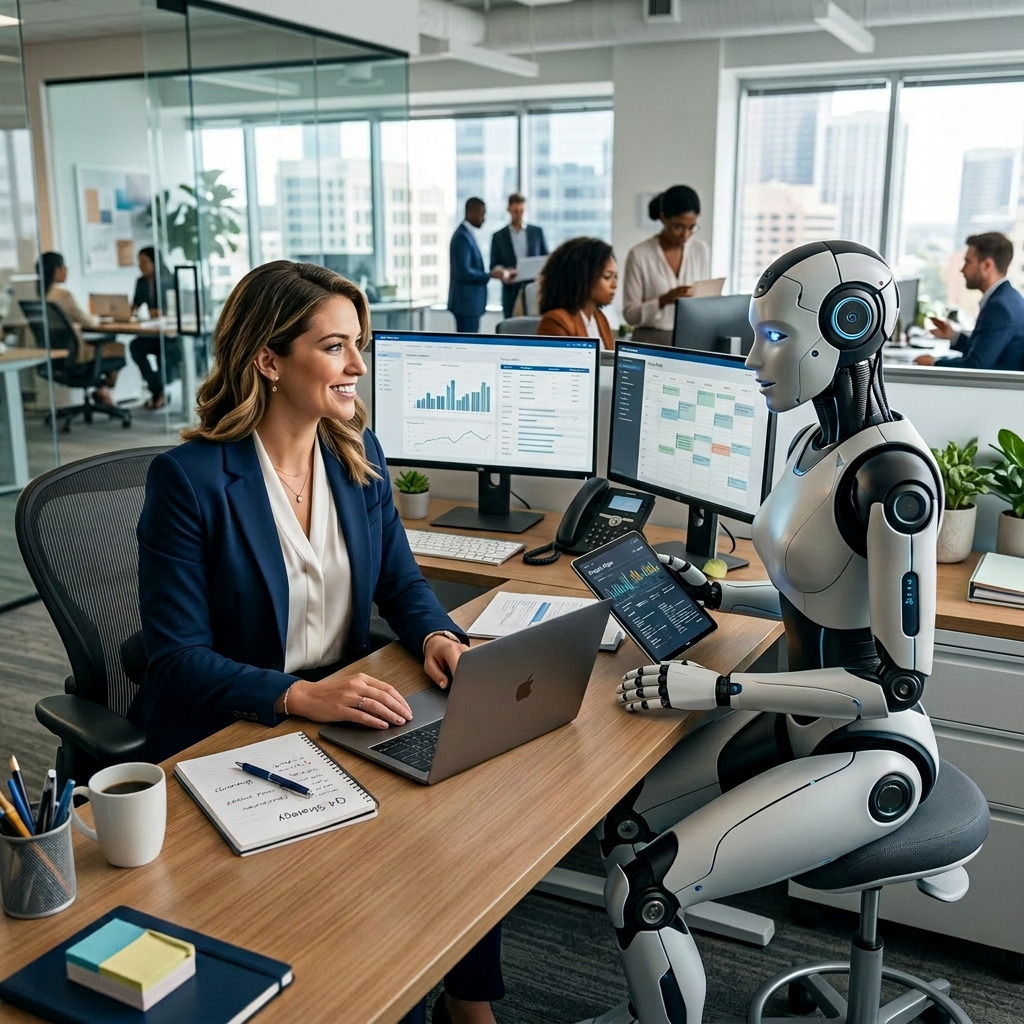
You cannot escape the noise surrounding AI and the effect it is having on jobs, particularly those in support roles.
I am an avid AI user. Claude, ChatGPT, Gemini. I use them all and I am fully invested. They make my day more efficient in ways that used to eat up hours. Researching a topic, remembering which Excel formula I need, summarising long email threads, building trackers, planning meals. Genuinely useful. Why wouldn’t you use these tools for that?
Those are administrative tasks. And if you think that’s what you hired your EA for, you’ve misunderstood what a good EA actually is.
EAs are not administrators with a fancier title.
Yes, we do the itty bitty stuff. All of it. But that is not our value. Our value is in something AI cannot replicate, the relationship we have with the people we support, and our ability to operate with context, judgement, and genuine investment in the outcome.
AI will absolutely replace EAs who do purely transactional work. Diary management, basic inbox sorting, that’s already being automated.
But a trusted EA who operates as a business partner? That’s a different conversation entirely.
We use our judgement.
We know when our client is about to lose it, and what they need to bring them back from the edge. We know when to send the email and when to quietly put it in drafts until tomorrow. We know that two people had a difficult conversation yesterday and the message that was planned for today will not land well. We know which things need to be loud and which need to be handled without a trace.
None of that is in the brief. It just comes from knowing someone.
We have all of the context.
The gap in the calendar is there for a reason and it is not available for meetings. The supplier who seems fine on paper has a history. The client who comes across as abrupt is actually just under pressure this month. We hold all of this and we use it, every single day, without being asked.
We work with discretion that goes beyond a privacy policy.
Confidential information, sensitive conversations, difficult situations. Clients are not handing that to a chatbot. They are trusting a person. Specifically, us. Because we have earned it.
What happens when it really matters.
There is a moment that stays with me. A client was travelling in the Middle East when the security situation deteriorated rapidly. No warning, no gradual build. One minute the trip was on, the next it wasn’t safe to be there.
They didn’t open a chatbot. They didn’t ask an AI tool to sort the flights. They called me.
On a Saturday.
And that is the point entirely.
I cancelled everything. Hotels, transfers, flights, the lot. I worked through it methodically, kept them updated, and made sure that by the time they needed to think about anything, there was nothing left to think about. They were able to step back from a stressful and potentially dangerous situation and trust that it was being handled. Not by a system. By me.
That is what a trusted EA relationship looks like in practice. Not the day-to-day diary management or the routine emails, but the moment when everything changes at once and someone needs to know there is a person on the other end who knows their situation, understands what matters, and will not stop until it is sorted.
AI cannot do that. Not because it lacks the capability to cancel a booking, but because no one is picking up the phone to call it when they’re just hours out from being due to fly into a war zone.
The things we were never told.
There is a version of this job that lives entirely on the surface. Tasks in, tasks out. Calendar managed, emails answered. Neat and transactional.
And then there is the real version.
After months of working closely with someone, being embedded not just in their business but in the rhythm of their life, you start to absorb things that were never explicitly said. Family arrangements. Who takes priority over work and when. The commitments that are non-negotiable, even if they never appear in the diary as anything more than a gap.
Nobody sat me down and gave me a briefing on this. I just paid attention. Over time it became part of how I think, woven into every decision I make on their behalf without them ever having to ask.
There was a moment recently where a meeting needed to move. On paper it was straightforward, find another slot, send the update, done. But I knew that the obvious alternative time didn’t work. Not because of another meeting, but because of something else entirely. Something personal, something that mattered, and something that would have caused unnecessary stress if I had just moved it there without thinking.
So I didn’t. I found another way, quietly, without making it a thing. The client never had to explain themselves, nobody had to have an awkward conversation, and it was done.
That is the job. Not the task itself, but the judgement that sits underneath it. The awareness of a whole person, not just a calendar.
An AI works with the information it is given. I work with everything I have learned about someone over time, and that is a very different thing.
The relationship is everything.
When you hire an EA, whether employed or freelance, you are not buying admin support. You are letting someone into the inner workings of your business. The good days and the bad ones. The decisions that keep you up at night and the wins you want to shout about. That requires trust, and trust is built between people. Not between a person and a tool.
Over time we know your history, your patterns, your triggers, your priorities. You tell us something once and you do not need to tell us again. A five-word email is enough for us to know what you need, why you need it, and why today is probably not the right day to ask questions.
AI can write you a perfectly worded email in seconds. It can mimic your tone once you’ve trained it. It can produce a polished draft that looks exactly right.
What it doesn’t know is that this particular client was furious last week. That there have been calls behind the scenes to firefight the situation ever since. That an email, however well-worded, is not what’s needed here.
AI has no stake in the outcome. No reputation on the line. No relationship to protect.
We do. And that is why we are not going anywhere.
To every EA reading this who is worried, stop.
I understand why the noise is unsettling. When every other headline is about AI replacing jobs, it is hard not to wonder where that leaves us. But I want to be clear, if you are a great EA, if you are embedded in your client’s world, if you are the person they call on a Saturday when everything goes wrong, you are not at risk. You are irreplaceable.
Our industry is not dying. It is being filtered. What remains is the work that only we can do. The relationships. The judgement. The trust that has been built quietly over months and years and cannot be downloaded, prompted, or automated.
Know your worth. Own your value. And stop apologising for being human, right now, that is your greatest asset.